

Summary
Industrial facilities generate massive amounts of data every day. But raw data alone doesn’t prevent failures or reduce downtime.
The real challenge? Turning that information into insights that actually matter. That’s where artificial intelligence, machine learning, and sound engineering logic come together.
With our Enertics product line, we’re bringing advanced analytics to industrial environments under the same reliability pressures utilities have faced for years. The goal is to understand what’s happening, catch problems early, and give operators the confidence to act before small issues turn into expensive failures.
Where AI and Engineering Logic Meet
There’s a lot of hype around AI and machine learning in industrial monitoring. The reality is more practical.
AI and ML excel at finding patterns in complex data sets, especially when those patterns change subtly over time. They detect anomalies that would be nearly impossible to catch manually. They identify trends that signal developing problems. They baseline normal behavior across thousands of operating conditions.
Algorithms alone aren’t enough. Industrial equipment operates in the real world, where physics, thermodynamics, and electrical theory matter. A temperature spike might be meaningful, or it might just be a hot day. Vibration changes could indicate bearing wear or reflect a change in production load.
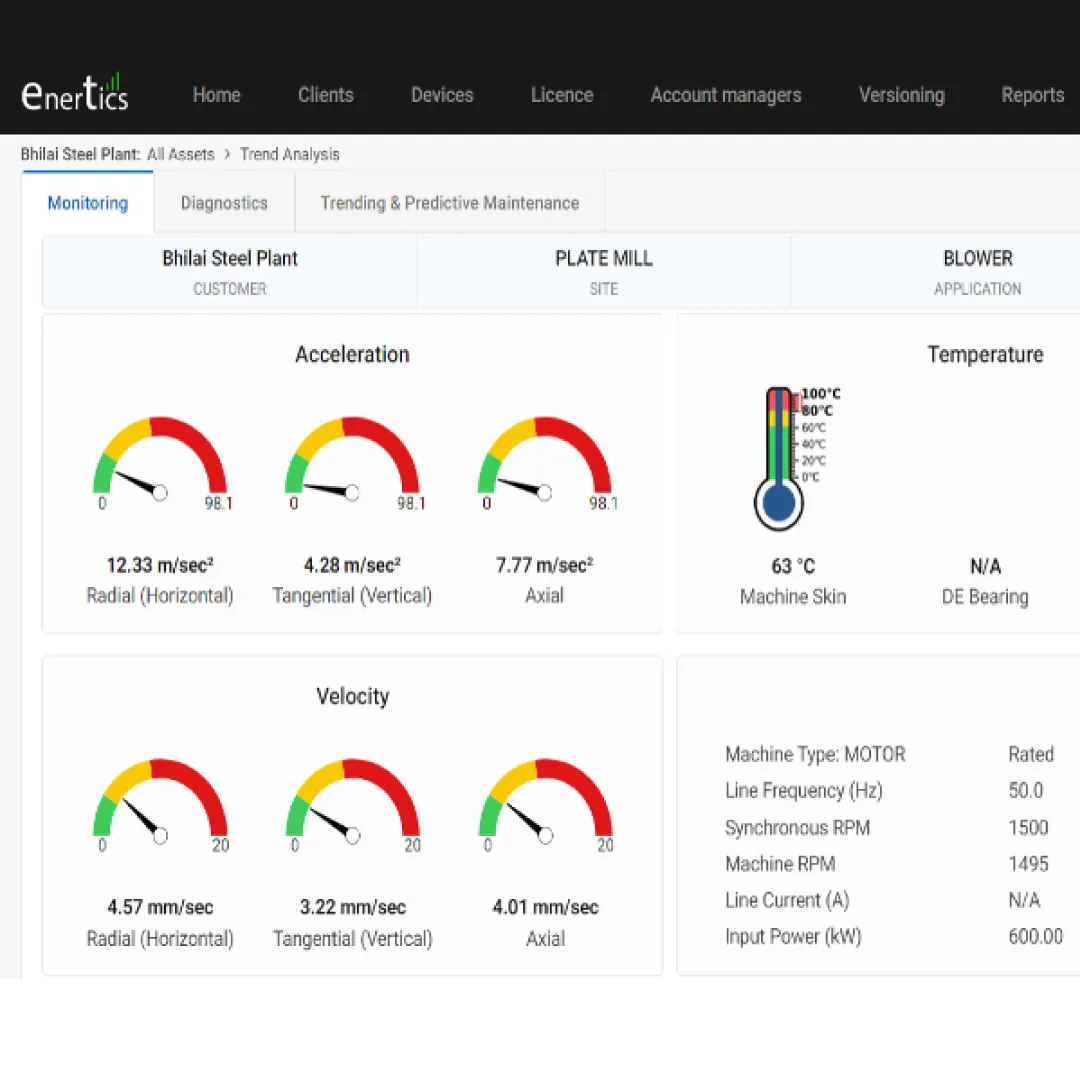
The Enertics analytics engine combines machine learning with engineering algorithms rooted in first principles. AI handles pattern recognition and trend analysis. Engineering logic provides the context to interpret what those patterns actually mean.
This system doesn’t just flag anomalies. It identifies real problems with the specificity and accuracy operators need to make decisions.
Granular Fault Detection in Action
The value of this approach becomes clear when you look at specific examples of what the system can detect.
Bearing Wear Detection
Bearings fail gradually. Early stages involve microscopic surface degradation that produces subtle changes in vibration frequency. As wear progresses, those frequency shifts become more pronounced. Secondary indicators like rising temperature and increased power draw start to appear.
Machine learning tracks these vibration signatures across the bearing’s operating history. It learns what normal looks like under different loads and speeds, then watches for deviations that match known wear patterns. Engineering algorithms cross-reference those signals with thermal data and motor current to confirm the diagnosis.
The system delivers specific diagnostics. You don’t get “something’s wrong with this motor.” You get “bearing wear detected in the outboard position, estimated 30-45 days to critical threshold based on current degradation rate.”
That level of detail lets maintenance teams plan repairs during scheduled downtime instead of dealing with an emergency shutdown.
Electrical Imbalance and Phase Issues
Electrical faults can be even harder to catch. They often develop intermittently. A loose connection might create resistance that only matters under heavy load. Phase imbalance might appear gradually as insulation degrades or connections corrode.
The analytics engine continuously monitors current, voltage, and power factor across all three phases. Machine learning identifies baseline behavior and detects when one phase starts drifting from the others. Engineering algorithms then assess whether that imbalance falls within acceptable tolerances or represents a developing fault.
When the system flags an electrical issue, it gets specific. It identifies which phase is affected, whether the problem is upstream or downstream, and how the imbalance is impacting equipment performance.
This kind of detail helps electricians diagnose problems faster and often prevents secondary damage to motors and other connected equipment.
Thermal Anomalies and Hot Spots
Heat is one of the most common early warning signs across industrial equipment. Thermal issues almost always come before mechanical or electrical failure.
Visual and thermal monitoring from the broader SWI platform provides real-time visibility into temperature conditions. The Enertics analytics layer adds depth by tracking how those temperatures change over time and correlating thermal data with other performance indicators.
Take a motor running hotter than normal. Machine learning determines whether it’s a gradual trend or a sudden change. Engineering algorithms check if the temperature increase aligns with a corresponding rise in load, or if it’s happening independently. That’s a sign of internal problems like winding degradation or ventilation blockage.
The system distinguishes between normal operational variation and genuine thermal anomalies that require attention. That keeps maintenance teams focused on real issues instead of chasing false alarms.
Real-Time Insight for Critical Equipment
One of the biggest advantages here is delivering insights in real time without overwhelming operators with noise.
Traditional monitoring systems create problems. Either they generate too many alerts and train teams to ignore them, or they rely on threshold-based alarms that only trigger after a problem has already escalated. Neither works well for critical equipment that can’t afford unplanned downtime.
The Enertics analytics engine takes a different approach. By continuously learning normal behavior and applying engineering context, the system understands when deviations are meaningful. It prioritizes alerts based on severity and confidence, so teams see the issues that actually matter.
For equipment running around the clock under tough conditions, this real-time visibility is essential. Operators don’t wait for the next inspection cycle or rely on manual data reviews. They know what’s happening with their assets right now. They have the information needed to decide whether to act immediately or schedule maintenance during the next planned outage.
Moving from Reactive to Predictive Maintenance
Condition-Based Monitoring is a major step forward from time-based or reactive maintenance. AI and machine learning take it further by enabling true predictive maintenance.
Detecting that a problem exists is valuable. But estimating when a failure is likely to occur? That’s what allows organizations to optimize maintenance schedules, reduce emergency repairs, and maximize asset uptime.
Machine learning makes this forecasting possible by analyzing failure progression rates. Once the system identifies an issue such as bearing wear, electrical imbalance, or thermal drift, it tracks how quickly that condition deteriorates. It compares current progression to historical data and known failure modes. Then the analytics engine projects when the equipment will reach a critical state.
This is data-driven forecasting backed by engineering principles. It gives maintenance teams the lead time they need to plan repairs, order parts, and coordinate shutdowns without disrupting production.
For facilities managing hundreds or thousands of assets, predictive maintenance transforms how work gets prioritized and executed. Resources go where they’re needed most.
An Evolution of SWI’s Commitment to Intelligent Monitoring
The integration of Enertics into the Systems With Intelligence portfolio represents more than an expansion into industrial markets. It’s an evolution of the same philosophy that has guided SWI’s approach to utility monitoring for years. Use advanced technology to deliver high-value, actionable insights that improve reliability and safety.
Utilities have been using Touchless™ Monitoring to move beyond periodic inspections and gain continuous visibility into substation assets. Now, with Enertics’ analytics capabilities, that same level of intelligent monitoring extends to industrial equipment.
AI and machine learning are practical tools. When combined with sound engineering logic, they help operators understand what’s really happening with their assets and make smarter decisions about maintenance.
For organizations managing critical industrial infrastructure, that combination of technology and expertise makes the difference between reacting to problems and preventing them.
Why This Matters Now
Industrial operations are under pressure from every direction. Equipment is aging. Skilled labor is harder to find. The cost of unplanned downtime keeps rising. Modern facilities are more complex, with more assets to monitor and more ways for things to go wrong.
AI and machine learning offer a practical path forward. They handle the heavy lifting of pattern recognition and trend analysis, freeing up engineers and maintenance teams to focus on what they do best: solving problems and keeping operations running.
With the Enertics product line integrated into SWI’s portfolio, industrial operators now have access to the same level of intelligent monitoring that utilities have relied on to improve reliability and reduce risk.
The technology works. The insights are actionable. The results speak for themselves. Fewer failures. Longer asset life. Maintenance programs that actually prevent problems instead of just responding to them.
That’s what happens when you combine AI, machine learning, and engineering logic in a way that respects the realities of industrial operations. It’s about turning information into action, and action into results.
Bobby Sagoo is CEO of Enertics Inc., a Systems With Intelligence Company.