

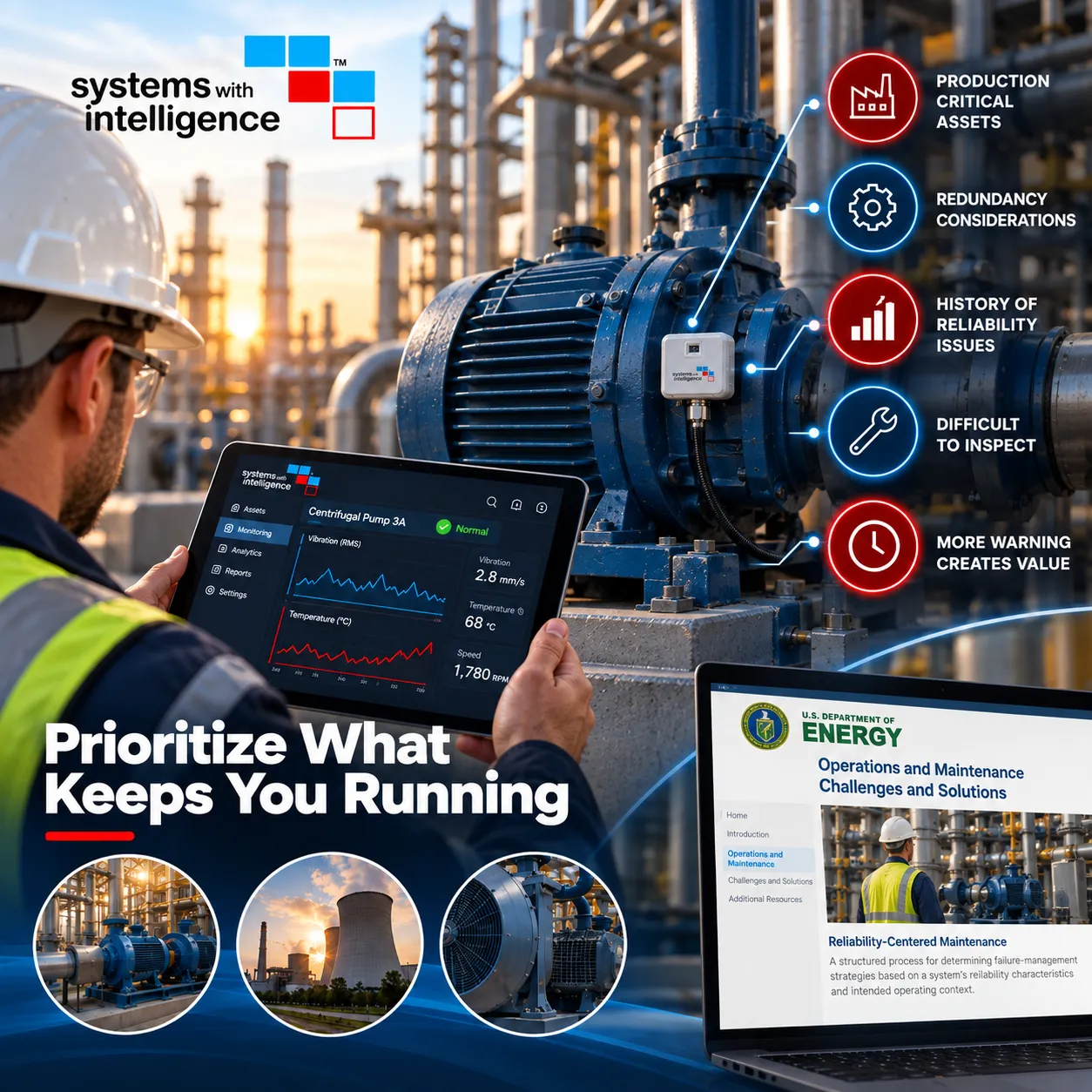
Most industrial facilities have more rotating equipment than it makes sense to monitor online at once. These machines can number in the hundreds or thousands, and their importance to the operation varies considerably.
The first decision is which assets warrant continuous visibility and where that visibility is most likely to improve maintenance planning.
Enertics’ experience with industrial customers shows that asset criticality matters, but replacement value alone does not determine it. Maintenance teams also need to consider redundancy, failure history, accessibility and whether earlier warning would materially change the response to a developing problem.
Start With the Consequence of Failure
A useful first question is “what happens to the operation if the asset becomes unavailable?”
An expensive machine may seem like an obvious monitoring priority, but purchase price provides only part of the picture. A smaller pump can be considerably more critical if its failure stops a production process, affects product quality, creates a safety concern or causes problems elsewhere in the system.
The same principle is reflected in the U.S. Department of Energy’s guidance on reliability-centred maintenance. The DOE describes reliability-centred maintenance as a structured process for determining failure-management strategies according to a system’s reliability characteristics and intended operating context.
For rotating equipment, operating context is essential. Two similar motors may have very different monitoring priorities if one supports a production-critical process while the other serves an application that can tolerate an interruption.
Determine How Much Protection Redundancy Actually Provides
Redundant equipment can reduce the consequence of an individual asset failure, provided the backup capacity is genuinely available.
A duty/standby pump arrangement may offer enough flexibility to take one machine out of service for maintenance. The calculation changes if both pumps are required during periods of high demand, the standby unit has its own reliability concerns, or transferring the load creates operational difficulties. This is why maintenance and operations personnel need to assess how redundancy works in practice.
Look at the Assets That Already Consume Maintenance Attention
Some rotating assets repeatedly experience bearing problems, alignment issues, imbalance, lubrication concerns or other mechanical conditions. Others may produce intermittent symptoms that are difficult to investigate during a scheduled inspection.
Online monitoring provides a continuous history of how the machine behaves over time. When a condition develops intermittently or under particular operating circumstances, maintenance personnel can review what happened before and during the event instead of relying solely on the machine’s condition at the time of inspection.
Enertics condition-monitoring systems can collect parameters including vibration and temperature, with additional sensing capabilities available depending on the equipment and configuration. Historical trending and diagnostic analysis can then help maintenance teams investigate developing conditions.
For equipment with recurring or difficult-to-diagnose problems, that additional history can make the asset a higher monitoring priority.
Consider How Difficult the Asset Is to Inspect
Some machines are straightforward to include on a routine vibration route. Others are located in restricted areas, hazardous environments or parts of the facility where inspections require additional planning.
Operating patterns can create another challenge. A machine that runs intermittently may be stopped when a technician arrives for a scheduled route. Another may exhibit unusual vibration only at a particular load or stage of the production cycle.
Continuous monitoring captures condition data as the machine operates under different loads and process conditions. For equipment that is difficult to inspect consistently under representative operating conditions, this can provide a more useful record of machine behavior.
Ask What the Maintenance Team Could Do With More Warning
One of the strongest tests for prioritizing an asset is whether earlier knowledge of a developing condition would change the maintenance response. This means asking questions like:
- If a bearing problem were identified weeks before it became severe, could the team order parts in advance?
- Could the work be coordinated with a planned outage?
- Could production be shifted temporarily?
- Could the team arrange specialist labor before the situation became urgent?
For a production-critical machine with a long repair lead time, earlier warning gives maintenance and operations personnel more options about when and how the work is performed.
Prioritize the Assets Where Several Factors Converge
No single criterion determines whether a rotating asset should be monitored online. The strongest candidates tend to emerge where several conditions occur together: meaningful consequences of failure, limited redundancy, recurring reliability problems, difficult inspection conditions or substantial value from earlier warning.
An online monitoring program also doesn’t need to start with every rotating asset in the facility. A carefully selected initial group lets maintenance teams focus continuous monitoring where the information delivers the greatest operational value.
Start with the maintenance decision the information is expected to improve. From there, it becomes easier to identify the right machines.
Learn more about our Rotating Equipment Monitoring Solutions, and contact us with any prioritization questions as you work through this process at your facility.
Bobby Sagoo is Managing Director at Systems With Intelligence