

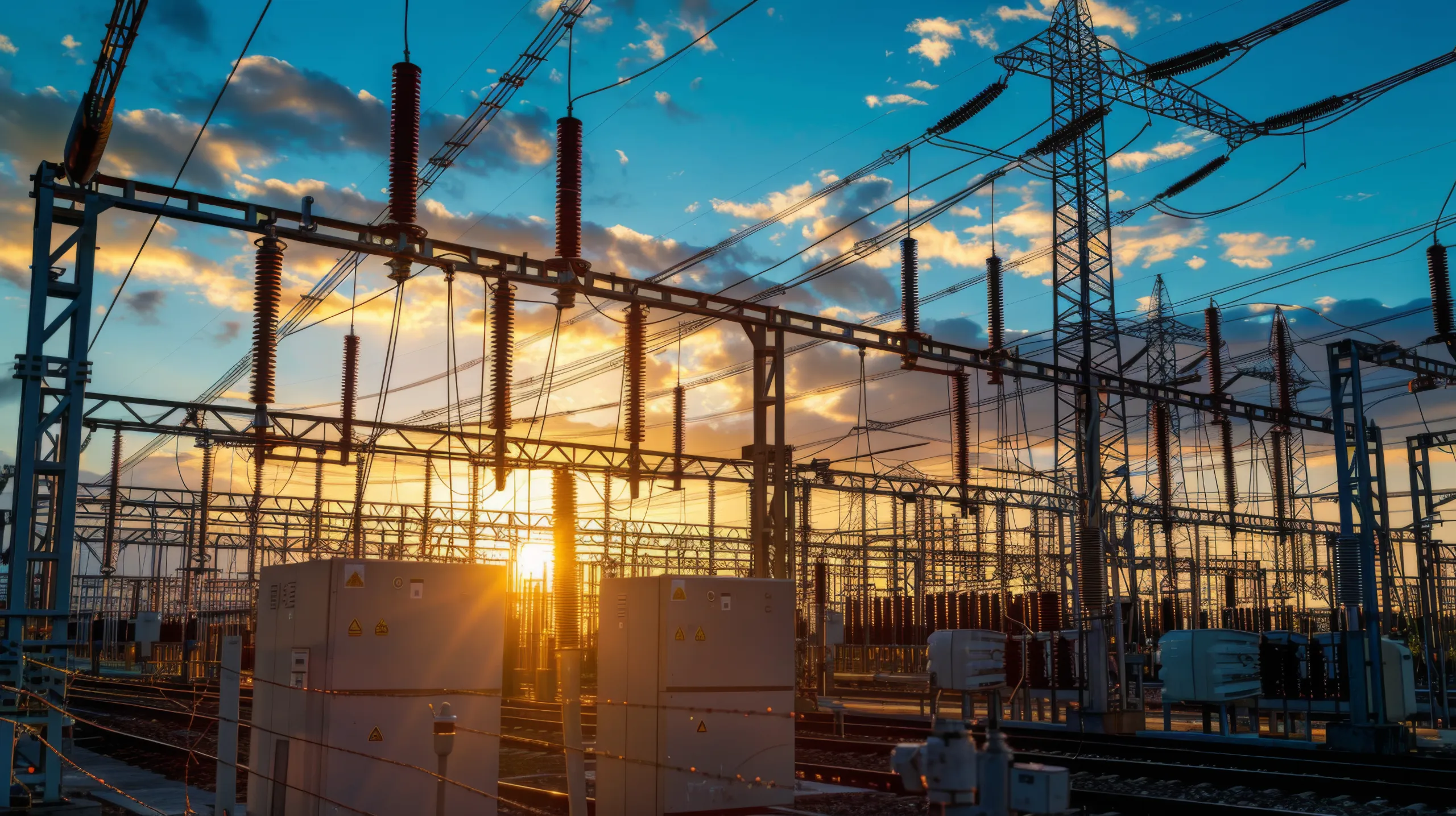
Artificial intelligence has arrived in the utility inspection space with considerable fanfare. Vendors promise automated fault detection, predictive maintenance, and continuous monitoring that will fundamentally transform how utilities manage their assets. Some of that promise is real. Some of it is not. And for a utility trying to make sound capital decisions in a space where hype and substance are genuinely difficult to separate, the difference matters enormously.
What AI Is Actually Being Asked to Do
Many of the failure precursors that matter in substation equipment are visual: oil leakage, insulator contamination, gauge drift, animal intrusion, vegetation encroachment, physical damage after weather events. These are the conditions that develop over time, that a trained inspector would catch on a site visit, and that an automated system must learn to recognize in their place.
Automated visual inspection uses artificial intelligence to analyze images collected by fixed cameras, drones, or ground robots, and to flag deviations from a known baseline. The system learns what healthy looks like for a given asset, and surfaces anything that looks different for human review.
That is a meaningfully different task from thermal inspection. Math handles most of what matters in thermal analysis without requiring probability or confidence scores. Visual inspection, by contrast, is inherently probabilistic. When AI reports that a gauge appears to be reading outside its normal range, it is really saying something closer to “based on what I have seen before, I believe there is a meaningful probability that something here has changed and warrants attention.”
That distinction is not a weakness. It is simply the nature of the task. Understanding it is the starting point for evaluating any vendor’s claims honestly.
The False Positive Problem and How Mature Programs Address It
Any probabilistic system produces false positives and false negatives, and automated visual inspection is no exception. Lower the detection threshold and the system catches more real issues at the cost of more false alarms. Raise it and the reverse is true. There is no threshold setting that eliminates both, and any vendor claiming otherwise should be evaluated with considerable skepticism.
What separates a well-engineered inspection system from a poorly designed one is the structural choices made to manage it.
One effective approach is a two-stage pipeline with a binary classification gate. Before attempting the harder task of anomaly classification, the system first asks a simpler yes-or-no question: does this image contain the thing the model is looking for at all? A binary gate trained to 90 or 95 percent accuracy on this narrow question prevents the classification stage from producing confident-sounding outputs on low-quality or ambiguous images, which is one of the most common failure modes in naive single-stage systems.
A second technique is persistence thresholding. Rather than flagging an anomaly the moment it is detected, a well-designed system requires that it appear consistently across multiple inspection cycles before surfacing it as a finding. This filters out transient noise: birds crossing the frame, sun reflections on equipment, momentary lighting changes, brief weather artifacts. The trade-off is a small amount of detection latency, which is entirely appropriate when most of the degradation that matters in substation equipment develops over days or weeks rather than seconds.
A third approach involves breaking hard problems into well-defined sub-problems. Gauge reading is a clear example. Reading a gauge sounds straightforward until you account for the variation in dial configurations, needle thickness, label formats, glass reflections, and lighting conditions across different equipment types and installations.
A pipeline that first locates the gauge, then identifies the needle, then reads its value relative to the label geometry, is considerably more reliable than one that attempts to produce a reading in a single step. Each sub-problem can be tuned and validated independently, which makes the whole system easier to audit and improve.
Where AI Is Not Yet Ready
The most ambitious version of automated inspection is a system that detects an anomaly, classifies the fault, and recommends a course of action. This is sometimes called the holy grail of the category. It is also, to be direct about it, years away from being appropriate for deployment in critical infrastructure.
The technical barriers are real. Probabilistic systems cannot achieve the reliability that fault determination in high-consequence environments demands. But the larger challenge is accountability. When an experienced asset expert identifies a fault, they are professionally accountable for that judgment. When an AI makes the same determination, accountability becomes genuinely ambiguous. Was a missed failure the fault of the operator? The AI developer? The consultant who deployed the system? The team that trained the model? These are not abstract questions. They are the questions that get asked after an hours-long outage, and they do not currently have clean answers.
The right role for AI at this stage of the technology’s maturity is to surface anomalies to the asset experts who carry accountability for the decisions that follow. The job of the inspection system is to make that expert work faster and better-informed. Not to replace it.
Data Consistency: The Prerequisite Nobody Talks About Enough
The success of any AI-based visual inspection program depends entirely on the consistency of its input data. A model trained to detect a developing fault on a bushing needs to see that bushing from the same angle and zoom level, under comparable lighting and load conditions, in every inspection cycle.
Load conditions matter more than most planning conversations acknowledge. The same asset at 40 percent load and 90 percent load produces very different thermal and visual signatures. An AI that does not account for this will either miss real problems or flag normal operational variation as anomalies. The field is moving toward models that incorporate load and environmental context, but reliable performance in these conditions is still an active area of development rather than a solved problem.
This is why fixed cameras, despite their coverage limitations, remain the foundation of the most effective automated inspection programs. Their positional consistency gives AI models the stable, comparable input data they need to build reliable baselines. Every dimension of variability the model must accommodate is a dimension along which it can be wrong.
What This Means for Utilities Evaluating the Technology
A partner that acknowledges what AI can and cannot do today is more valuable than one promising capabilities that do not yet exist in production-ready form. The technology available right now is genuinely useful. It can meaningfully reduce the inspection labor required to monitor a fleet of substations. It can catch developing faults that manual inspection would miss between scheduled visits. It can shift experienced inspectors from routine site visits to higher-value review and analysis work.
What it cannot do, at least not reliably, is replace the expert judgment that determines what a finding means and what to do about it. That distinction is not a limitation of a vendor or a particular platform. It is where the technology honestly stands.
Systems With Intelligence’s white paper, The Promise of Automated Inspection in Electric Utilities, examines the AI models behind visual inspection in detail, including how different pipeline architectures manage the false positive problem, what data consistency requirements look like in practice, and how to build a business case that reflects what the technology can actually deliver. It is the right starting point for any utility that wants to move beyond the hype and make decisions grounded in how this technology actually performs in the field.
John Nam, VP of Engineering, Systems With Intelligence