

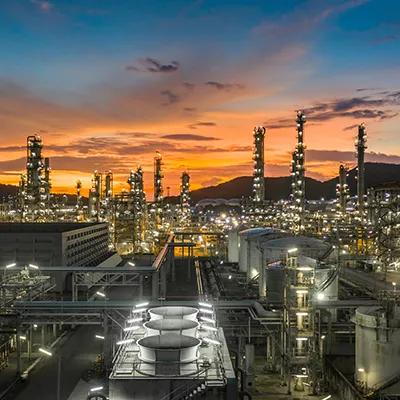
Critical vessels sit at the center of refinery and chemical processing operations. Because they routinely handle extreme pressure, heat, and hazardous substances, even a small failure can lead to toxic releases, fires, explosions, or runaway reactions.
These plants rely on a mix of tools to track vessel health and confirm structural integrity. But many of these methods have real blind spots, which raises the odds that a small issue slips by unnoticed until it escalates into a much bigger problem.
Continuous Critical Vessel Monitoring closes many of these gaps by giving operators far richer visibility into temperature and performance trends. Because the technology works across virtually any vessel type, it adapts to a wide range of use cases, strengthening safety, sharpening operational efficiency, and cutting maintenance spend.
To learn more, download our latest white paper: Improving Safety and Reliability in Petrochemical Plants With Continuous Critical Vessel Monitoring.
How Continuous Critical Vessel Monitoring Works in the Field
These systems pair advanced thermal and visual imaging to deliver round-the-clock coverage of the full vessel surface.
Operators gain visibility into temperature levels, rate of change, and min/max/average differentials, making it possible to spot anomalies and hotspots the moment they emerge, well before they signal a genuine fault.
Built to HazLoc standards for Class I and Class II environments, the ruggedized sensors require no physical contact with the vessel, which makes installation, upkeep, and day-to-day use straightforward.
Most petrochemical companies begin with a pilot deployment to evaluate the technology and determine how it fits into their broader Asset Integrity Management Strategy. For the fastest payoff, it helps to run that pilot at a facility with known problem areas or older equipment that already demands frequent upkeep.
From there, companies can expand deployment across additional units and sites, giving operators a single, centralized view of vessel conditions across the entire facility footprint.
Catching Faults Earlier
Traditional monitoring approaches offer some insight into vessel condition, but because their coverage isn’t continuous, certain issues can go unnoticed until it’s already too late to intervene.
Continuous monitoring, by contrast, picks up on intermittent or localized temperature shifts across a variety of operating conditions well before pressure or process alarms ever sound. Full-surface, real-time thermal visibility lets operators catch the subtle deviations that typically precede a failure.
Shifting to Condition-Based Maintenance
Scheduled maintenance runs on a fixed calendar, driven by past records or usage benchmarks rather than real-time condition. It can lower failure risk, but it also results in maintenance performed too early or unnecessarily on equipment that didn’t need it yet.
Continuous monitoring gives petrochemical companies the data needed to shift toward Condition-Based Maintenance. Instead of servicing equipment that’s still performing well, operators can time maintenance around the asset’s actual condition, at the point that makes the most financial sense.
Optimizing Process Performance
Continuous Critical Vessel Monitoring plays a meaningful role in strengthening safety, but that’s not all it delivers. Used well, it also becomes a powerful lever for optimizing processes and boosting overall performance.
By capturing real-time, full-field thermal data, the technology shows exactly how heat and reactions are distributed within and across a vessel. Thermal cameras flag temperature patterns that point to process inefficiencies, and tracking those patterns over time helps plants fine-tune fuel use, keep product quality consistent, and boost yield, all while cutting waste and reinforcing safety.
Turning Temperature Data into a Competitive Advantage
Critical vessels are central to refinery and chemical manufacturing operations. Continuous Critical Vessel Monitoring adds a layer of coverage that traditional tools can’t match, giving operators a full temperature picture of the vessel across every operating condition.
With that expanded access to data, operators can catch minor faults early, build out a Condition-Based Maintenance program, and fine-tune operations.
To dig deeper into Continuous Critical Vessel Monitoring and how petrochemical facilities are putting it to work, download our white paper: Improving Safety and Reliability in Petrochemical Plants With Continuous Critical Vessel Monitoring
Jon Lowenberg, VP of Solution Delivery & Customer Support, Systems With Intelligence