

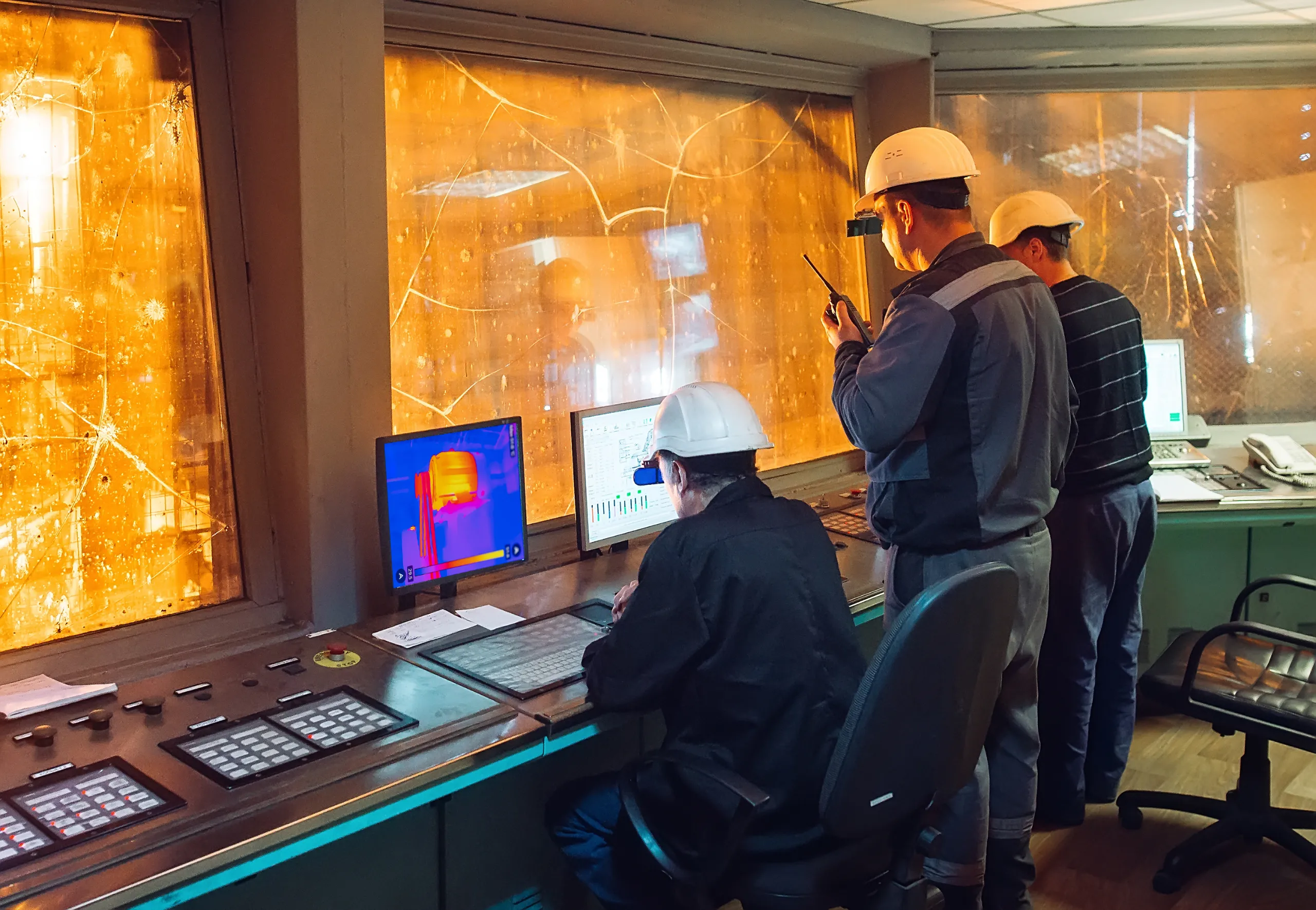
Steelmakers already understand the operational demands of ladles and electric arc furnaces, as well as the consequences of missing early signs of refractory degradation or cooling-system failure. The challenge is gaining enough condition visibility to make better maintenance decisions before those risks become operational events.
What has changed is the amount of condition information available between inspections.
Continuous Thermal Monitoring gives operations and maintenance teams a way to follow the thermal behavior of ladles and EAFs while they are in service, rather than relying only on periodic inspection, heat counts, scheduled maintenance and the accumulated judgment of experienced personnel. This
adds another layer of evidence to decisions that are already being made every day.
For steel plants, four applications are key:
- Reducing ladle-breakout risk
- Improving relining decisions
- Detecting cooling-water leaks in electric arc furnaces
- Tracking furnace-wall deterioration over time
Each involves a different failure mechanism, but the underlying advantage is the same: a developing condition can be evaluated as a trend rather than discovered as a single point-in-time finding.
-
Reducing Ladle-Breakout Risk
Ladle refractory rarely deteriorates uniformly. Localized wear, cracking, erosion or damage can create areas where heat begins transferring through the lining differently from the surrounding shell. The plant may still have a ladle that appears serviceable overall, while one region is moving toward a condition that requires intervention. This is where continuous thermal data becomes useful.
A fixed thermal monitoring system can track the shell repeatedly as the ladle moves through normal production and compare temperatures across defined areas from heat to heat. The objective is to track whether any abnormality persists, whether it is growing, and whether it is behaving differently from the established thermal pattern for that vessel.
This changes the quality of the maintenance discussion. A refractory team can evaluate a developing condition against the ladle’s thermal history, then decide whether the vessel should remain in service, undergo closer inspection, or be removed from rotation.
Continuous thermal monitoring can identify localized shell-temperature changes associated with refractory thinning or cracking, giving maintenance teams more time to assess the condition before it develops into a breakout risk. That additional thermal history supports more confident decisions about inspection, continued service, and when to remove the ladle from rotation.
-
Making Relining Decisions With More Confidence
Relining strategy has always involved a trade-off between risk and remaining useful life. Pull a ladle too early, and the plant gives up refractory life, labor and production time. Push it too far, and the consequences can be much more serious.
Heat counts, inspection findings, operating history and refractory practice will continue to drive those decisions. Continuous thermal history adds another way to judge whether the lining is performing as expected.
A ladle that maintains a stable thermal profile over time presents a very different maintenance picture from one developing a persistent localized increase in shell temperature. The first may justify continued service despite a conservative calendar or heat-count threshold. The second may justify intervention before the nominal relining point has been reached. That distinction is important because it moves the decision closer to actual condition.
In practical terms, continuous monitoring can also help maintenance teams determine whether the issue is localized enough to support a targeted repair rather than a full reline. That does not eliminate the need for inspection or refractory expertise; it helps narrow where those resources should be applied and when.
For plants under pressure to protect throughput without compromising safety, this has direct economic value. Relining becomes less about following a fixed interval and more about understanding how the refractory is actually behaving under the operating history of that particular ladle.
-
Detecting EAF Cooling-Water Leaks Earlier
Cooling-water systems around electric arc furnaces introduce a different kind of risk. Water near molten metal is necessary for safe and effective furnace operation, but a leak can quickly become a serious operating hazard.
The challenge is that a small leak may develop before there is an obvious visual indication or before the condition becomes severe enough to trigger another form of detection.
Continuous thermal monitoring can add an earlier signal by identifying localized temperature behavior on the shell, roof or cooling panels that departs from the expected pattern. Continuous thermal monitoring can help identify cooling-system failures and abnormal shell-temperature patterns early enough for maintenance teams to investigate before the condition develops into a more serious operating problem.
However, context matters. An EAF is not a thermally stable environment. Charging, melting, tapping and changes in production load all alter the profile of the furnace, so a single temperature change is not useful on its own.
The advantage of continuous monitoring is comparison. A system can track how a given region normally behaves during a particular operating phase and flag a deviation that persists or develops in an unexpected location. That gives the maintenance team a reason to investigate before the problem becomes obvious for the wrong reasons.
The practical benefit is additional warning time. In an environment where the difference between a controlled response and an emergency can be very small, that matters more than simply having another sensor.
-
Tracking Furnace-Wall Deterioration Over Time
Furnace-wall wear is inherently progressive as refractory is repeatedly exposed to heat, slag chemistry, mechanical stress, and thermal cycling, and the resulting deterioration is rarely identical around the vessel. Periodic inspection can identify the furnace condition at the time of inspection. Continuous monitoring adds the ability to see how that condition is changing.
As refractory loses thickness or insulating effectiveness, the external thermal profile can begin to shift. A section that repeatedly runs hotter than its historical baseline may warrant closer attention, particularly if the anomaly becomes more pronounced over successive cycles. The value is in the direction of travel.
A one-time hot area may be associated with process conditions. A region that returns repeatedly, expands or increases in intensity is much harder to dismiss. That history lets maintenance personnel focus on where degradation is progressing and supports better decisions about partial repair, outage timing, and when to take the furnace out of service.
For experienced teams, this is a more useful application of thermal monitoring than simply setting a temperature threshold. The question is whether its thermal behavior is changing in a way that suggests the refractory is no longer performing as it has before.
Better Data, Better Timing
Continuous Thermal Monitoring is most valuable in steelmaking when it improves the timing and confidence of decisions that already exist within the operating model:
- Should this ladle remain in service?
- Is a full reline justified, or is the issue local?
- Does this thermal pattern warrant investigating an EAF cooling circuit?
- Is a section of furnace wall degrading quickly enough to move maintenance forward?
Those are operating questions, and they remain in the hands of the people who understand the process, the asset and the consequences of acting too early or too late.
Our Viper steel monitoring approach supports that judgment by providing continuous thermal information on ladles, EAFs, and other critical equipment, while complementing established inspection and maintenance practices rather than replacing them.
For steel plants, the advantage is having enough history to distinguish a temporary condition from a developing one, and enough warning to choose the response rather than have the failure choose it.
To explore these applications in greater detail, download Viper Imaging’s white paper, Mitigating Risk in the Steel Industry – The Benefits of Continuous Thermal Monitoring.
Rich Shannon is the Vice President of Sales at Systems With Intelligence.