

Every substation manager would like to inspect more often. The real challenge is what to do with the crews and hours they have. When resources are fixed, inspection planning stops being a scheduling exercise and becomes a series of judgment calls about where a visit will do the best.
Those judgment calls used to live in people’s heads. A senior technician knew which station ran hot every August and which breaker had an unwritten history. That knowledge is thinning out. The Center for Energy Workforce Development’s 2023 Energy Workforce Survey found that 56 percent of utility employees have less than 10 years of service, and non-retirement attrition has reached its highest point since the survey began in 2006. I think the practical response is to prioritize and document it, so the reasoning survives whoever happens to be doing the scheduling this year. In my view, a workable inspection priority list comes down to five inputs, which are asset criticality, condition indicators, consequence of failure, inspection history, and accessibility.
1. Start With Criticality
Criticality is about the job an asset does in the network rather than the shape it is in. A transformer feeding a hospital or a large industrial customer belongs in a different tier from one on a lightly loaded residential feeder that can be backfed from a neighboring station. In this situation, redundancy deserves as much weight as load. A station with N-1 capability can lose a unit and keep supplying its load, while a radial station has no such margin, and that difference should be visible in any ranking. Criticality rarely changes unless the network does, which makes it a stable starting point for the ranking, with the other four inputs adjusting priorities from here.
2. Let Condition Drive the Week-to-Week Changes
If criticality sets the baseline, condition is what should move assets up or down the list. Thermal anomalies at bushings and connections, dissolved gas trends, oil levels, partial discharge activity, and visible corrosion all tell you something about where an asset is heading. A moderately critical transformer with a hotspot that has climbed over three readings should get a visit before a highly critical unit that has been stable for years.
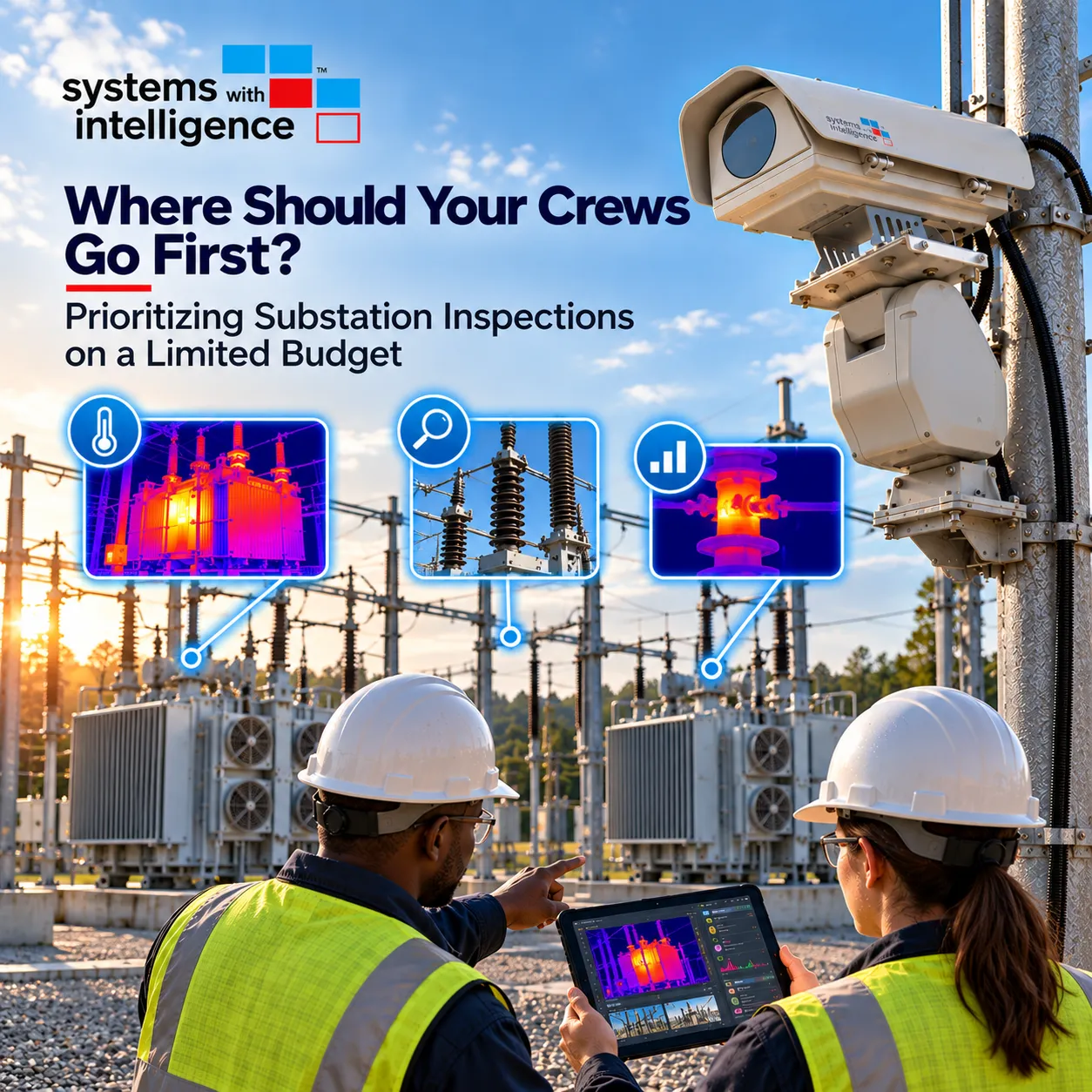
The frustrating part is that most of this information only arrives when someone is on site, which is exactly what most organizations lack. This is where I see continuous thermal and visual monitoring earning its place, since it lets condition data keep coming in between visits instead of waiting for the next one.
3. Think Past the Asset When Weighing Consequence
Consequence of failure is related to criticality, but it goes further by asking what happens on the day an asset fails.
- How long were customers out, and who are they?
- Was there a fire or oil release risk, and who was nearby?
- What else in the yard got damaged?
4. Treat Inspection History as a Trend
Most utilities have years of inspection records, but the asset managers and maintenance planners who review them usually look at one visit at a time. If they read them as a trend, patterns start to show up, such as recurring hot connections or slow oil seepage. None of those findings may have been urgent on its own, but together they describe an asset that is drifting. The opposite is also useful. A station with a long run of clean results is a fair candidate for a longer interval. I would also flag any station deferred two or three cycles in a row, since not knowing its condition is a risk.
5. Be Honest About Accessibility
Remote stations often get inspected less because they are hard to reach. Long drives, seasonal roads, and special transport requirements quickly eat into crew time. I would rather see that cost acknowledged in the model than hidden in the schedule. For high-criticality sites that are difficult to reach, remote monitoring usually makes more sense than repeatedly sending a crew out to confirm that nothing has changed.
6. Putting It Together
None of these five inputs should decide the order on its own. Score each station against all five, weight them to match your risk tolerance and regulatory obligations, and revisit the ranking regularly. The result is a ranking someone new to the team can pick up, understand, and defend, rather than one that depends on whoever has been around longest.
Want a second opinion on your substation inspection ranking? Contact us to have a qualified system engineer share options.
Fausto Della Rovere is the Chief Technology Officer at Systems With Intelligence