

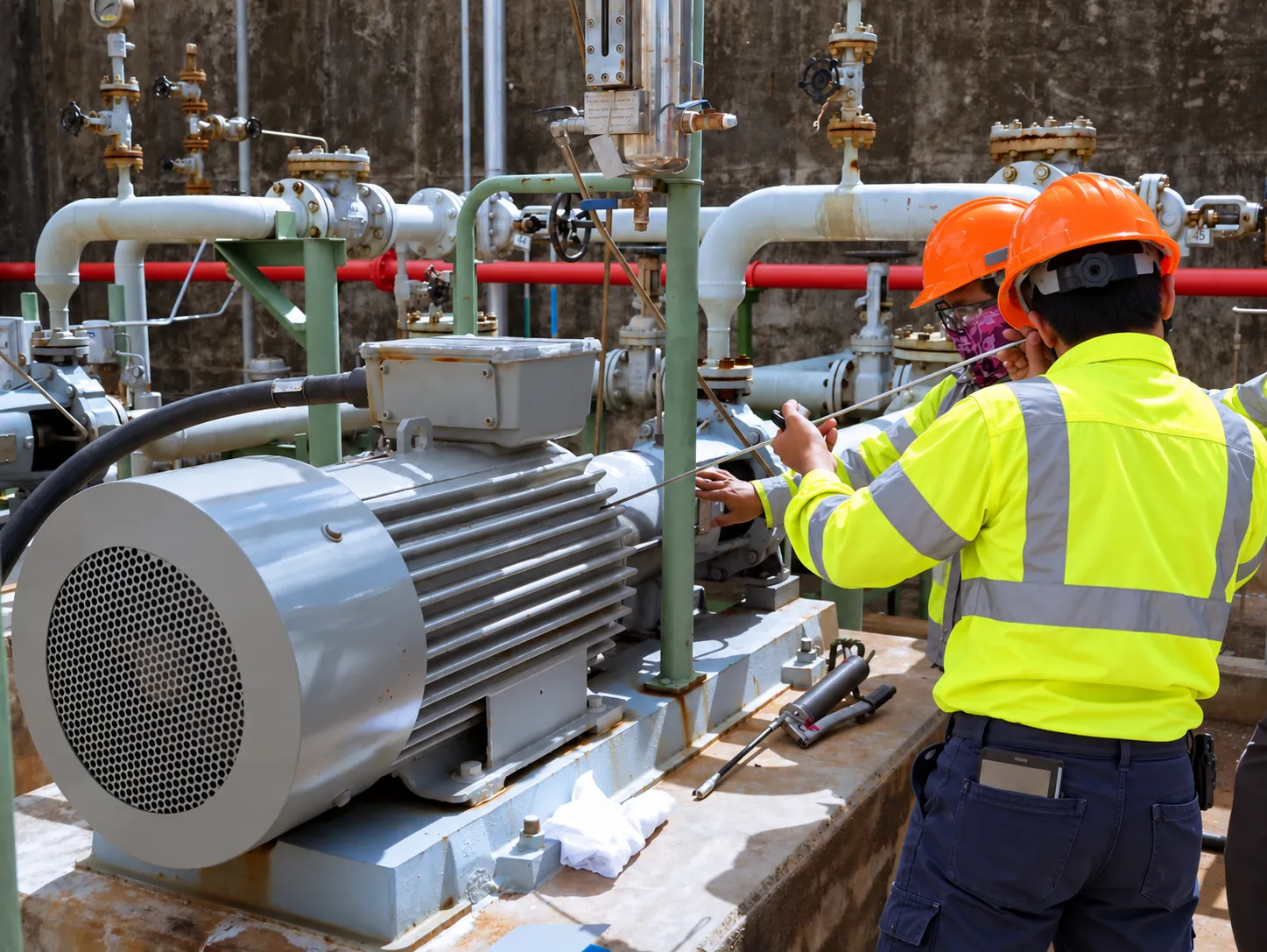
The biggest change continuous vibration monitoring makes to a maintenance organization is that it changes how people spend their time.
A traditional route-based program sends skilled technicians into the plant to collect readings on a schedule. Much of that work is necessary because the maintenance team does not know which machine has changed since the last visit.
Continuous monitoring reverses that logic. The data collection happens in the background and the maintenance team begins its work with a smaller, more valuable question: which assets are behaving differently enough to deserve attention?
That shift sounds subtle, but it changes planning, triage, troubleshooting and the timing of maintenance interventions. It also changes the technician’s role from primarily gathering condition data to interpreting what the data means in the context of the machine and the process.
What it does not do is remove human judgment. In fact, the more information a maintenance team receives, the more important good judgment becomes.
Periodic Routes Tell You What a Machine Looked Like
Vibration analysis has been one of the more dependable tools in rotating-equipment maintenance for decades.
A competent analyst can identify signatures associated with imbalance, misalignment, looseness, bearing damage and other mechanical conditions.
The weakness is in how often the measurement is taken. A monthly route provides twelve views of a machine over a year. Everything in between has to be inferred, creating an obvious blind spot for faults that begin shortly after an inspection, but also a less obvious one: operating context.
A pump may run smoothly at one load and vibrate abnormally at another. A motor may exhibit a developing condition only during a particular production cycle. A gearbox may look acceptable during a scheduled route and behave very differently several hours later when throughput rises. Continuous monitoring captures those changes because it sees the machine under the conditions the machine operates.
Over time, that produces something a periodic route cannot: a history.
For maintenance teams, history changes the quality of the question. Instead of asking whether vibration is high today, they can ask whether it has been rising, how quickly it is rising and what else changed at the same time.
SWI’s Enertics system, with its multi-sensor monitoring and AI-based predictive analytics, is built around that view. Its sensors combine vibration, acoustics, magnetic flux and temperature, allowing the analytics to compare several indicators rather than treat each signal in isolation. This approach is one reason the system can identify some developing bearing faults weeks or months before failure, rather than only after the condition has become severe. That lead time is what changes maintenance work.
The Route Gives Way to the Exception
A route-based program is calendar-driven. Technicians know which assets are due for inspection, collect the readings, review the results and decide where follow-up is required. Continuous monitoring makes the exception the starting point.
Healthy assets continue to generate data, but they no longer require the same amount of human attention to prove that they remain healthy. The maintenance team can spend more time on assets whose behaviour has changed. That does not mean fewer maintenance people, it means those people can be deployed differently.
A vibration analyst can spend less time collecting routine readings and more time validating developing conditions. A planner can have more notice to arrange parts and labour. A mechanic may arrive at the machine knowing which component is suspect instead of starting with a broad troubleshooting exercise.
An Alert Is Not an Instruction to Shut the Machine Down
An alert is evidence, it is not a maintenance decision. When a monitoring system identifies a change, the team still has to determine what the change means, and that process begins with validation:
- Has the operating load changed?
- Did the vibration shift coincide with a process change?
- Is temperature moving in the same direction?
- Are acoustics showing a corresponding pattern? Has the asset shown the same behaviour before?
- Is the condition persistent or transient?
The value of a system such as Enertics is that it can narrow the problem before the technician begins that review.
The analytics platform combines machine learning with engineering algorithms and is designed to identify specific fault modes rather than simply report that vibration has increased. That level of detail is useful because it shortens the path from alert to investigation, it does not eliminate the investigation. A maintenance team still has to decide whether the finding is credible, how serious it is and whether the asset can continue operating until a planned maintenance window.
Those decisions depend on things no vibration algorithm can fully capture on its own: process criticality, redundancy, production commitments, spare-parts availability, recent maintenance history and the consequences of failure. The analytics can identify the technical condition, the maintenance team still owns the operating decision.
Continuous Monitoring Adds Rate of Change to the Conversation
Periodic inspection is well suited to answering: is there evidence of a problem during this inspection? Continuous monitoring adds a more useful dimension: how fast is the problem developing?
A vibration level that has been elevated but stable for two months presents a different maintenance problem from one that has increased sharply over three days, this is where trend data becomes operationally important. Once a fault is identified, the maintenance team can watch the progression rather than simply react to the threshold. If degradation is slow and stable, the repair may be planned for the next scheduled outage. If the rate of change accelerates, the timeline may move forward. If related indicators begin changing as well, the team has more evidence that the condition is becoming more serious. This is how continuous monitoring creates planning time. In industrial maintenance, those days or weeks of notice can be more valuable than the diagnosis itself.
Human Judgment Moves Up the Value Chain
The argument for continuous monitoring is sometimes framed as a labour-saving story which is only partly right. It can reduce the amount of skilled time spent gathering routine information, but it increases the value of the judgment applied afterward.
Experienced maintenance people understand context. For example, they know that a vibration increase on a lightly loaded redundant fan does not carry the same consequence as the same change on a single critical pump feeding a production line. They know whether a machine has a history of alignment problems, whether a recent overhaul changed its baseline and whether a process upset is likely to explain an unusual reading.
Enertics’ own support model reflects the point. Some customers review and interpret their own condition data. Others use Enertics analysts for reporting, deeper analysis and discussions about corrective or preventive action. The software can bring the right machine to the top of the queue, but experienced people still need to decide what to do with it.
The Maintenance Team Stops Looking for Trouble and Starts Managing It
The most important difference between periodic inspection and continuous vibration monitoring is that the work is organized around different assumptions:
- Periodic inspection assumes the maintenance team has to go looking for developing problems on a schedule
- Continuous monitoring assumes the system can watch the machine continuously and bring evidence forward when its behaviour changes.
This difference lets maintenance teams spend less time proving that healthy assets are still healthy, and more time deciding how to respond to the machines that are not. Physical inspection, vibration expertise, mechanics, planners and reliability engineers remain important.
What changes is when they enter the process and how much they know when they do. Instead of arriving at an asset with a handheld instrument and asking whether something is wrong, the team can arrive with a trend, a likely fault mode and a clearer sense of how quickly the condition is developing. This is maintenance judgment getting better information earlier.
Bobby Sagoo is Managing Director at Systems With Intelligenc